




Search engine optimization (SEO) is an essential part of building a strong online presence. Whether you run a local business, e-commerce store, service company, or professional website, ranking higher on search engines can help you attract relevant visitors and generate more business opportunities.
SEO involves several techniques, but two of the most important areas are on-page SEO and off-page SEO. Although both have the same overall goal of improving search visibility, they focus on different aspects of a website.
Understanding the difference between on page and off page SEO can help businesses create a more balanced and effective optimization strategy.
What Is On-Page SEO?
On-page SEO refers to the optimization activities performed directly on your website. These activities help search engines understand your content and determine whether your pages are relevant to a user’s search query.
On-page optimization also focuses on improving the experience visitors have when they land on your website.
Some important elements of on-page SEO include:
Keyword Optimization
Keywords help search engines understand the main topic of a webpage. Relevant keywords should be naturally included in important areas such as headings, content, title tags, meta descriptions, URLs, and image alt text.
However, keyword placement should always feel natural. Overusing keywords can make content difficult to read and may negatively affect the overall user experience.
Title Tags and Meta Descriptions
The title tag tells search engines and users what a webpage is about. A well-written title can improve relevance and encourage clicks from search results.
Meta descriptions provide a brief summary of the page and can help users understand what they can expect after clicking the result.
Quality Content
Content is another important part of on-page SEO. Pages should provide useful, original, and relevant information that matches the user’s search intent.
Instead of creating content only for search engines, businesses should focus on answering customer questions, explaining their services, and providing genuinely helpful information.
Headings and Structure
Using H1, H2, and H3 headings helps organize content into clear sections. A structured page is easier for visitors to read and helps search engines understand the context of different sections.
Internal Linking
Internal links connect related pages on the same website. They can help visitors navigate through the website while also helping search engines discover and understand other important pages.
Technical Optimization
Website speed, mobile usability, crawlability, image optimization, URL structure, and other technical elements also contribute to effective on-page SEO.
Also Read : Instagram Reels vs. YouTube Shorts: Which Format Wins for Your Brand in 2026?
What Is Off-Page SEO?
Off-page SEO focuses on activities that take place outside your website to improve its authority, credibility, and online reputation.
While backlinks are a major part of off-page SEO, the strategy can also include brand mentions, business citations, digital PR, reviews, and other activities that increase a website’s visibility across the internet.
Link Building
Backlinks are links from other websites pointing to your website. When relevant and authoritative websites link to your content, these links can contribute to your website’s authority.
Quality is more important than simply creating a large number of backlinks. Links should ideally come from relevant, trustworthy sources.
Business Listings and Citations
Local businesses can benefit from maintaining accurate information across relevant business directories and listing platforms. Consistent business information can support local visibility and help customers find the business online.
Digital PR and Brand Mentions
When a business is mentioned by reputable publications, blogs, or industry websites, it can increase brand awareness and create opportunities for referral traffic and backlinks.
Social Media Visibility
Social media can help businesses distribute content and increase brand awareness. While social media activity does not replace SEO, greater brand visibility can help attract audiences who may eventually visit, mention, or link to the website.
Online Reviews
Genuine customer reviews can play an important role in building trust, particularly for local businesses. A positive online reputation can influence potential customers when they are comparing different businesses.
Difference Between On-Page and Off-Page SEO
The primary difference between on page and off page SEO is where the optimization takes place.
On-page SEO focuses on elements that you can control directly on your website, such as content, keywords, headings, internal links, title tags, meta descriptions, and technical improvements.
Off-page SEO, on the other hand, focuses on external signals that can influence how search engines and users perceive your website. These include backlinks, brand mentions, citations, digital PR, and online reputation.
| On-Page SEO | Off-Page SEO |
| Takes place directly on your website | Takes place outside your website |
| Focuses on content and website optimization | Focuses on authority and reputation |
| Includes keywords and headings | Includes backlinks and brand mentions |
| Includes internal linking | Includes external link building |
| Includes title tags and meta descriptions | Includes citations and digital PR |
| Focuses on relevance and user experience | Focuses on credibility and authority |
Both approaches serve different purposes, which is why businesses should not rely on only one of them.
Why Do You Need Both On-Page and Off-Page SEO?
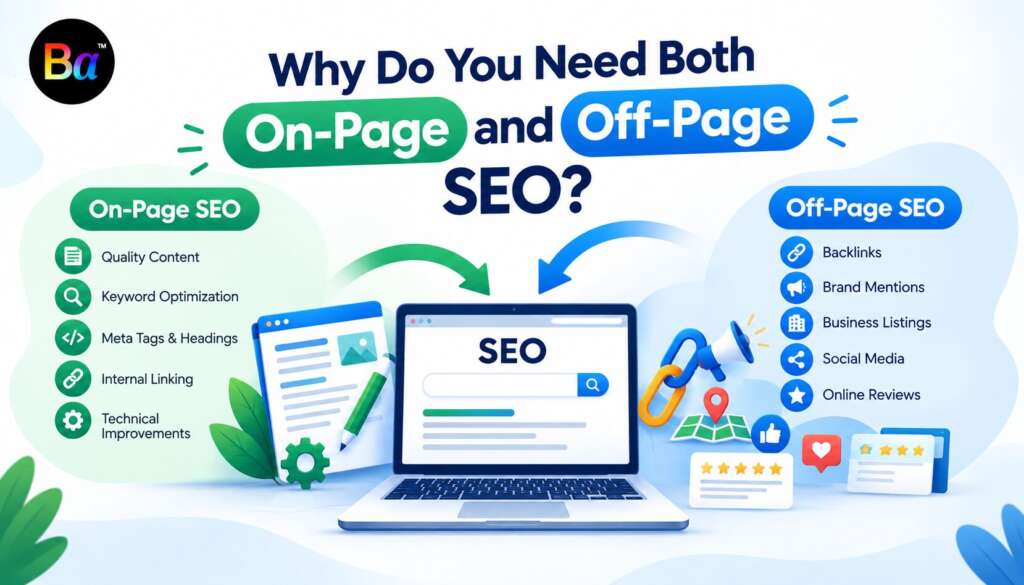
Understanding the difference between on page and off page is important, but knowing how to combine them is even more valuable.
A website can have excellent content and technical optimization but still struggle to compete with established websites if it has limited authority. Similarly, a website may have several backlinks but fail to perform well if its content does not satisfy search intent or its technical foundation is weak.
Using both strategies creates a more complete SEO approach.
Better Search Visibility
On-page optimization helps search engines understand your website, while off-page SEO helps build its authority. Together, they can create stronger opportunities for improved search visibility.
More Relevant Traffic
Optimized content can help a website target relevant searches. When combined with a strong off-page strategy, businesses can increase their chances of attracting users who are genuinely interested in their products or services.
Stronger Online Authority
Quality backlinks, brand mentions, and digital PR can strengthen a business’s online presence, while well-optimized pages demonstrate relevance and provide value to visitors.
Sustainable Growth
SEO requires consistent effort. Regularly improving website content, fixing technical issues, targeting relevant keywords, and developing quality external signals can support long-term organic growth.
How Brandvertise Can Help With SEO
Implementing both on-page and off-page SEO requires proper keyword research, content planning, technical optimization, link-building strategies, and regular performance monitoring.
For businesses that want to improve their online presence, Brandvertise provides digital marketing solutions designed around individual business goals and target audiences.
Its SEO approach can include keyword research, on-page optimization, content development, technical SEO, local SEO, and off-page activities such as relevant link building and online visibility campaigns.
For businesses targeting customers in Hyderabad, choosing the right digital marketing services in Hyderabad can help create a structured strategy for improving search visibility and generating relevant website traffic.
Rather than treating SEO as a one-time activity, businesses should continuously analyze performance and make improvements based on search trends, competition, user behavior, and website data.
Create a Complete SEO Strategy
The difference between on page and off page SEO comes down to their primary focus: on-page SEO improves elements within your website, while off-page SEO builds authority and credibility through external activities.
Neither approach should be treated as a replacement for the other. A strong SEO campaign combines optimized content and technical foundations with quality backlinks, brand visibility, citations, and reputation-building activities.
If your business wants to increase organic visibility, attract relevant traffic, and build a stronger digital presence, combining both on-page and off-page SEO can provide a more comprehensive foundation for long-term growth.
With the right strategy and consistent optimization, SEO can help businesses turn search visibility into valuable website visits, enquiries, and customers.
Conclusion
On-page and off-page SEO work together to create a strong and sustainable search engine optimization strategy. While on-page SEO focuses on improving your website’s content, structure, keywords, and user experience, off-page SEO helps build authority, credibility, and trust through external signals such as backlinks, brand mentions, citations, and reviews.
Understanding the difference between on page and off page SEO is important, but the real value comes from implementing both strategies consistently. A well-optimized website combined with a strong off-page presence can improve search visibility, attract relevant traffic, and support long-term business growth.
If you want to strengthen your website’s online presence and compete more effectively in search results, working with an experienced SEO and digital marketing services in Hyderabad provider like Brandvertise can help you build a strategy based on your business goals, audience, and industry competition.
Also Read : How Logo And Branding Services in Hyderabad Influence Customer Buying Decisions?
