

A custom software company in Hyderabad can help businesses overcome industry-specific challenges by creating technology solutions designed around their actual workflows, customers, and operational requirements.
Every business has its own way of working. A hospital manages patient information, appointments, and medical records. A logistics company needs to track vehicles, deliveries, and inventory. A growing retailer may need better systems for managing customers, orders, and payments.
Using the same software solution for all of these businesses may seem convenient, but it does not always address their specific requirements. This is where custom software development becomes valuable.
Instead of forcing a business to change its entire workflow around an existing application, custom software can be designed around the way the organization already operates.
Why Off-the-Shelf Software Isn’t Always Enough
Ready-made software can be useful for common business requirements. However, companies often discover limitations as their operations become more complex.
An off-the-shelf application may contain features a business does not need while missing functions that are essential to its daily operations. Employees may then have to use spreadsheets, multiple applications, manual processes, or workarounds to complete simple tasks.
This can create unnecessary complexity.
For example, a company may use one platform for customer information, another for accounting, and a separate tool for internal communication. When these systems do not communicate properly, employees may spend additional time entering or transferring information.
A custom solution can bring important functions together and create a more connected workflow.
Also Read : Why a Branding and Advertising Agency in Hyderabad Is Essential For Modern Business Growth?
How a Custom Software Company in Hyderabad Understands Industry Needs
Custom software development starts with understanding the problem rather than immediately writing code.
A professional development team can study how employees currently perform their tasks, where delays occur, what information needs to be stored, and which processes could be automated.
This process helps identify the actual technology requirements.
For example, a manufacturing company may need software for production planning, inventory management, supplier information, and quality control. A healthcare organization may require appointment scheduling, patient management, billing, and secure record handling.
These businesses have completely different requirements. Their software should reflect those differences.
Creating Software Around Real Business Workflows
One of the biggest benefits of industry-specific software solutions is that the technology can be designed around existing business processes.
Instead of employees constantly adjusting their work to match the limitations of a software package, the software can be structured around the organization’s workflow.
Consider a logistics business that manages hundreds of shipments every day. Its system may need to handle order allocation, vehicle tracking, delivery updates, driver information, and customer notifications.
A generic application may handle some of these functions but require additional tools for the rest.
Custom software can connect these processes into one system, reducing unnecessary manual work and making information easier to access.
Solving Problems Through Automation
Manual processes can consume a surprising amount of time.
Employees may repeatedly enter customer information, generate reports, send notifications, update records, or check data across different systems. While each task may take only a few minutes, the total time can become significant over weeks and months.
Business process automation can reduce this repetitive workload.
For example, software can automatically generate invoices after an order is completed, send reminders when a payment is due, update inventory after a sale, or notify a manager when a particular task requires attention.
Automation does not necessarily mean removing people from the process. Instead, it allows employees to spend less time on repetitive administrative work and more time on tasks that require human judgment.
Also Read : On-Page vs Off-Page SEO: Difference, Benefits & Why Both Matter?
Improving Data Management
Businesses generate large amounts of information every day. Customer details, transactions, employee records, inventory information, sales figures, and operational data all need to be stored and accessed efficiently.
Poorly organized data can lead to duplicate entries, outdated information, reporting errors, and delays in decision-making.
A custom system can provide a centralized business data management structure where authorized employees can access the information they need.
For example, a sales team could view customer interactions while management accesses performance reports. Different departments can work with the same underlying information instead of maintaining disconnected spreadsheets.
This can make everyday operations more organized and reduce unnecessary duplication.
Developing Scalable Technology for Growing Businesses
A software system that works for a small company may not be suitable when that company grows.
The number of customers may increase, more employees may join the organization, new locations may open, and additional services may be introduced.
This is why scalable software development is important.
Custom software can be planned with future requirements in mind. Developers can create a system that can accommodate additional users, features, integrations, and data as the business expands.
For a growing company, this can be particularly useful because technology does not have to be completely replaced every time the organization reaches a new stage.
Connecting Different Business Systems
Many businesses rely on multiple digital tools.
A company might use accounting software, customer relationship management systems, payment gateways, inventory platforms, communication tools, and analytics applications.
When these systems operate independently, information may have to be transferred manually.
Custom development can help businesses create software integration solutions that allow different systems to exchange information more efficiently.
For example, an e-commerce business could connect its website with inventory management and accounting systems. When a customer places an order, relevant information can move between the systems automatically.
This can reduce repetitive data entry and improve the overall flow of information.
Improving Customer Experiences
Technology does not only affect employees. It also influences how customers interact with a business.
Slow websites, confusing booking processes, delayed updates, and poor communication can negatively affect the customer experience.
Custom applications can be designed around the specific expectations of a business’s customers.
A healthcare provider, for example, could offer online appointment scheduling and automated reminders. A service company could create a customer portal where clients track requests and receive updates.
These features can make interactions simpler and more convenient.
Better Security and Access Control
Different industries deal with different levels of sensitive information.
Healthcare providers, financial businesses, educational institutions, and professional organizations may all need systems that carefully control who can access particular information.
Custom software can incorporate secure software development practices and role-based access controls according to the organization’s requirements.
For example, employees in one department may only need access to operational information, while administrators may require broader access.
Security should be considered from the beginning of development rather than treated as an afterthought.
Supporting Better Business Decisions
Good decisions depend on good information.
When important business data is scattered across different spreadsheets and applications, it can take considerable time to understand what is actually happening.
Custom software can include dashboards, reporting tools, and analytics features that present relevant information in a more accessible format.
A retail company, for instance, could monitor sales performance, inventory levels, customer activity, and product demand through a centralized dashboard.
This can help management identify patterns and respond to changing business conditions more quickly.
Why Hyderabad Businesses Are Investing in Custom Development?
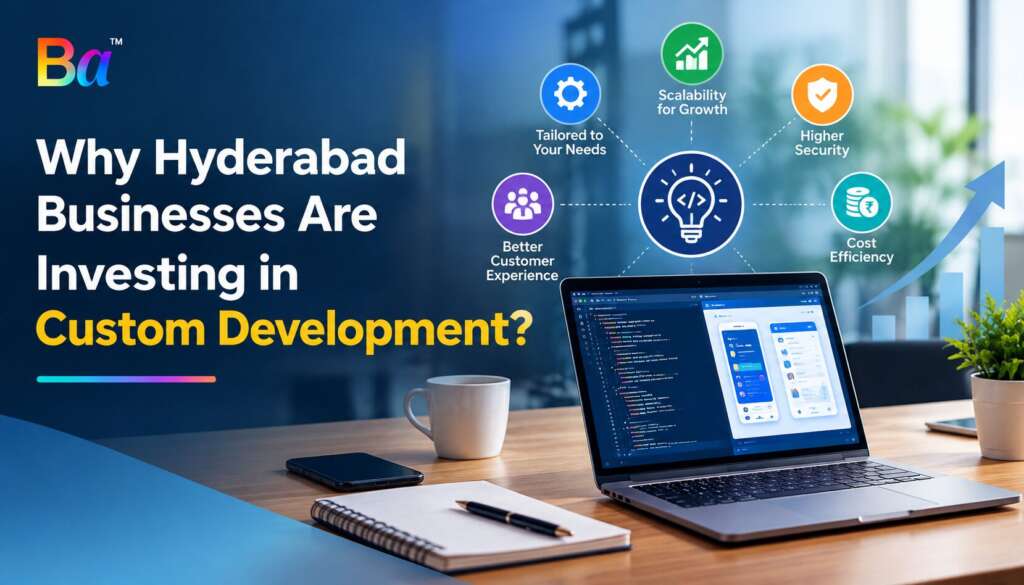
Hyderabad has a diverse business environment that includes technology companies, startups, healthcare organizations, manufacturers, retailers, educational institutions, and professional service providers.
As businesses in these sectors become increasingly dependent on digital processes, their technology requirements can become more specialized.
A custom software company in Hyderabad can work with businesses to identify these requirements and develop solutions that match their operational needs.
The advantage is not simply having new software. It is having technology that serves a specific business purpose.
Choosing the Right Development Partner
Choosing a development company should involve more than looking at technical skills.
Businesses should consider whether the development team understands their industry, communicates clearly, follows a structured development process, and provides support after deployment.
It is also important to discuss scalability, security, integrations, timelines, maintenance, and future updates before development begins.
A strong development partnership starts with understanding the business problem and then selecting the appropriate technology to solve it.
Also Read : Why Most Brands Fail on Social Media Without a Social Media Marketing Agency in Hyderabad?
Conclusion
Technology becomes more valuable when it solves a real problem rather than simply adding another digital tool to the business.
A custom software company in Hyderabad can help organizations address specific operational challenges through tailored applications, automation, integrations, data management, and scalable technology.
Whether a business needs to simplify internal processes, improve customer experiences, connect different systems, or manage complex industry requirements, custom software can provide a more flexible approach than forcing every organization into the same ready-made solution.
For modern businesses, the goal should not simply be to adopt more technology. It should be to use the right technology to make everyday work more efficient, connected, and adaptable.
